Posts

Showing posts with the label estate planning

Retirement Accounts and Conduit Trusts and SECURE Act. What Do I Need to Do???

The recent passage of the “ Setting Every Community Up for Retirement Enhancement” Act (SECURE Act) in December 2019 created some significant changes to retirement accounts.  One big change of SECURE resulted in changes to allowing what is commonly referred to as “stretch” IRA’s. Previously, beneficiaries such as children and grandchildren, were able to have funds withdrawn from an inherited retirement account over the rest of their expected life. That allowed younger beneficiaries to extend (or stretch) the IRA distributions over several years, or potentially decades for very young beneficiaries. The result was that the taxable income was spread over a long period of time that allowed the account to continue to grow (hopefully). With a few exceptions, the stretch IRA is no longer an option and funds from a traditional IRA/401k must be withdrawn within ten (10) years of your passing. Many clients incorporated provisions in your estate plan that used the “conduit” trust as a ...

Effect of Divorce in Iowa Estate Planning: Do I Need to Change My Will to Keep My Ex Away?

Image
First and foremost, I don't handle divorces and won't go further with any divorce questions because my knowledge ends with that.  In 20+ years of practice, handling a divorce 20 years ago was good enough to put away those materials. But for those that have gone through a divorce, there is typically the question about how a divorce impacts your estate plan documents.  The Iowa legislators realize that many people don't go through the process to update their estate plans after a divorce, so they have implemented a series of code sections throughout the Iowa Code that essentially provide that if you get a divorce, any provisions that provide for your beloved "ex" are ignored.  Those various code sections are consolidated here to help you sleep a little easier at night: Iowa Code section 598.20A provides that if you list your ex-spouse (or relatives of your ex-spouse) as your beneficiary of life insurance, that designation is ignored. Iowa Code section 598.20B ...

Take That Step

Image
This past year, I had the opportunity to go skydiving. What a blast! I had wanted to skydive for a while so I was anxious to jump out. However,  when you are on the edge of the plane door, looking out at the ground several thousand feet below you, a slight pause is a natural feeling. Thinking about your possible demise can be unnerving. Similarly, sometimes doing your estate planning can have the same feeling.  Unfortunately death is a certainty for all of us and it doesn't necessarily get any easier later on. As I stood on the edge of the plane, I didn't pause long as my tandem guide jumper basically pushed me out (with him and the parachute thankfully).  My job as your estate planning attorney is to do the same thing. Push you out of the plane!  Or, better yet, to get your affairs in order (just in case that parachute doesn't open).

Avoid Inheritance Taxes in Iowa? Adopt that Nephew!

Image
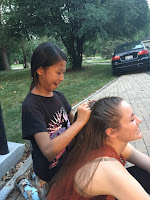
Adoption can be a wonderful thing.  My niece, in this picture, is adopted and she is a wonderful addition to our family.  However, adoption can have some funky applications in the estate planning world.  A recent ruling from the Iowa Supreme Court was interesting on a couple of issues involving an adoption: To avoid paying inheritance taxes for a bequest to a non-lineal descendant, a nephew was adopted by his aunt. Even though he was adopted by his aunt, the son's biological mother was still able to include an inheritance for her son. The first point is not all that unusual and I have advised clients of this very option.  Basically, whether you are adopted or biological, as a child in Iowa, you do not pay any inheritance tax when you inherit from your parents.  But, if you are a nephew, cousin, friend (basically a non-lineal descendant) there is an inheritance tax owed on an inheritance based on this table .  So, if reducing a tax bill is worth chan...

The Trusted Trustee: Who Gets to Have All the Fun?

Image
When you are putting together your estate plan (and shame on you if you haven't done so yet) one of the decisions you may face is 'who should be the trustee?' This question assumes that you are using a trust.  Whether it is due to young beneficiaries, special needs, or other circumstances that call for managed control of assets, a trustee is the title assigned to person/entity.  So what are the requirements? Capable - A trustee needs to handle investments, accounting, and tax returns.  Some people's brains turn to mush with visions of talking cats when faced with dealing with financial issues.  Your Uncle Bob might be a great guy, but if he is putting a name to the talking cat and not looking at investment returns and allocations, he might not be the best choice for trustee. Discretionary - Sometimes trustees have to make tough decisions.  These may not be popular decisions with the beneficiaries and Uncle Bob may not want to disappoint his nephew/niece...

Now and Later: Power of Attorney Authority in Iowa

Image
When I was younger, I used to love Now and Later candy , despite the "workout" it gave my mouth/teeth.  You can enjoy the candy as a hard candy, and continue to enjoy it later when it is soft and chewy. It was like having having a different piece of candy, all in one piece. When I discuss a power of attorney document with a client, one of the questions that I go through is whether they want the authority to be a springing power or an immediate power.  For example, do you want the person you identify to have authority to act on your behalf only when your doctor says you don't have sufficient capacity? Or, alternatively, do you want that person to have authority immediately , regardless of your capacity level? For many clients (and for many attorneys) the initial thought/answer is 'why would you give someone power over your assets when you don't need any help?'  Here are my three responses: 1.  You may have sufficient capacity, but you aren't around....

Basic Estate Planning Checklist for Aging Parents

I have previously posted previously pretty much on all of these items separately, but I thought I'd commit to the "checklist-mania" and add my own checklist.  For individuals that are helping out with an aging family member, this can be a quick guide to get you started.  (If you are taking advantage of an aging family member, then you need to get a conscience and turn yourself into the authorities.) While this list can be used for pretty much anybody, young or old, this can be a helpful guide for those assisting a parent/grandparent with planning. Power of Attorney (health) - This document enables health care decisions, such as medicine, doctor, facility, therapy, etc. to be made by a selected individual.  While more than one can be named, it is typically preferred to name one responsible individual. Power of Attorney (financial) - This document provides for someone to handle financial matters.  Iowa's recently updated statute provides significant changes to th...

Governor Branstad Signs New Uniform Power of Attorney Bill in Iowa

Well, it was a long time coming, but following unanimous passage in the Iowa House and Iowa Senate, today Governor Branstad signed the Uniform Power of Attorney bill into law.  The Uniform POA is a substantial and long-overdue replacement to the current power of attorney statute (Iowa Code chapter 633B). The statute is applicable to ALL power of attorney documents, whether signed before or after the effective date of July 1, 2014. Some key points from the Uniform act: (1) provides for improved remedies in event of abuse/misuse of authority; (2) clear guidance for agents; (3) addresses powers involving co-agents; (4) specific and general authority of agents; and (5) statutory form to use for individuals without attorney access.

How to Own Land in Iowa...Let Me Count the Ways

Well, in the past week, I had 3 different calls involving issues of how land was owned and resulting problems when one of the owners passed away.  It is not unusual, apparently, for individuals to prepare their own deeds or to not have deeds provided to them not reviewed by experts (and no, realtors and bankers don't necessarily qualify as experts in this area).  Sometimes, even attorneys have problems with these issues.  (Probably those attorneys that graduated from the University of Iowa.)   (Sidenote to realtors, bankers and Iowa law grads - please enjoy the good-natured humor.  For the Iowa law grads, ask a Drake law grad to read these big words to you.) Listed below are the more common options on ownership of real property in Iowa that could be placed on a deed with joint ownership.  Note two things I just indicated:  these comments apply to real property (you know, land, dirt, back 40...not your car) and land located in Iowa .  These same...

Even the Rich and Famous Fail to Plan Properly

Philip Seymour Hoffman obviously had several demons involved in his life before its tragic premature ending, and maybe updating his estate plan wasn't at the top of his list.  However, the legacy he left his family and friends is probably not one that he would have wanted.  It does, however, give this trusts and estates lawyer an opportunity to demonstrate how each of us can learn from PSH's errors (besides not doing drugs). As reported in Forbes , PSH's will was signed after his first-born, but was not updated when his next two children were born.  Now, like in NY, the laws will typically provide some protection for "after born heirs" (those kids born after a will) but with some missing language in PSH's, plus some other problems, the issue will not be clearly determined until the court's get involved. In Iowa, a child born after the execution of a will and which they are not provided for under the provisions of the will, will receive the amount the...

Too Embarrassed to Ask "What is Probate"?: Fear No More: Probate in Iowa

"Probate" is a term that is often mentioned (well, maybe not often) but many people don't understand what it really involves. Probate is the legal process where, through a court-supervised system: (1) a deceased individual's assets are transferred to their rightful heirs/beneficiaries; (2) taxes are paid; and (3) debts/claims are handled. The probate process also includes the validation of a will.  (How else can you prove it is the last will of the decedent.)  Probate also determines the rightful heirs and beneficiaries.  Quite the tool that probate. It is not necessary to have the attorney who drafted the will handle the process. The "administrator" or "executor" can select whatever attorney they choose.  The "administrator" or "executor" is the individual appointed by the court to handle the various steps in probating an estate.  If there is a will, they are called the executor.  If there is no will, they are called the admin...

Using Jointly Owned Property to Avoid Probate: Good Idea?

A common question that frequently comes up, in an effort to avoid the "evil" world of probate, is the use of joint ownership to transfer property.  I'm sure you all know that jointly owned property will automatically pass to the surviving joint owner after one dies.  For example, mom and daughter are joint owner on bank account, mom dies, daughter automatically becomes new owner of account immediately.  Simple and easy. Right? Sometimes it works.  But, let's play some "what if" scenarios: What if the daughter has creditor problems - her creditors can go after and garnish the joint account and take the money away from mom. What if the daughter has tax liens and garnishment? What if there are other intended beneficiaries and the daughter decides she doesn't want to share with the others.  She has no legal obligation to divide the money out. What if there are bills for mom that need to be paid after her death? What if the daughter decides to "...

I'm Only [insert age] Years Old, So I don't Need a Will.

A common question that I get is "when do I need a will?"  Not everyone needs a will, but there are a few situations where a will becomes pretty important in allowing your friends and family to handle your final affairs.  Some examples of key situations: Young children - Your will can indicate your preference as to who will be raising your kids.  This issue can be ripe with conflict if there are multiple individuals that love your children and want the job.  That love can lead to competition.  A Will can calm that storm, or at least help.  Real estate - If you own real estate, your will provides directions on how it is handled and distributed, but it also allows your personal representative to handle its disposition easier and without court involvement.   Second marriage with children from prior marriage- you love your current spouse, and you love your children from a prior relationship, but that doesn't mean your spouse and kids will always ...

FINALLY...Estate Tax Rules Updated for 2013

Image
Almost exactly 2 years ago, I blogged on the updated federal estate taxes for 2011 and 2012 and noted that the rules put in place then were just punted down the road.  That "punt" finally landed when the "Fiscal Cliff" doomsday of 1-1-13 approached. Finally , today we received some updated rules on the federal estate tax system for 2013 and beyond.  (Can I say "permanent"?).  I'll update more on the details of the statute after it is digested, but essentially most of the rules from 2012 will remain in place.  (Slightly more than $5 million exemption per person and continued portability options for spouses.) The Iowa Academy of Trust and Estate Counsel have a quick summary of the tax bill here . I expected this to happen, but I'm often wrong when it comes to predicting what Congress will do.  At least we have a better set of rules to work with and estate planners will know what to tell clients for the future.

Inheriting Iowa Farmland

With a recent ISU survey showing Iowa farmland values continuing to skyrocket , there is an increase in attention to dealing with the big values involved. Some issues to keep in mind when your estate involves Iowa farmland: "Death Taxes" - For 2012, the federal estate tax exemption amount is $5M , which excludes are large portion of the individuals dying in 2012.  However, for the larger estates, or estates with significant life insurance or retirement plans, there may be some issues.  Also, in less than a year, the exemption amount is scheduled to be reduced back to $1M.  With just a 150 acre farm, at average values, you potentially have estate tax exposure. Disputes - Handling the farm if there is more than one child can be challenging.  What if there is one child that is involved in farming and one that isn't?  What if neither are involved?  What if the kids don't get along with each other? How will decisions be handled in the future when there a...

Honey, I lost my will!!

Hopefully you've done the proper thing and put together an estate plan.  But what do you do with the original will?  The original will is an extremely important document.  In Iowa, as in many other states, if the original will cannot be located, there is a presumption under the law that the decedent intentionally destroyed the will.  Even if you can find a copy of a signed will, it may not be enough.  It is possible to argue to a court that it was not revoked, but the law requires you to show by clear and convincing evidence that they did not destroy (revoke) the will. So, some options and things to think about for storing a will: Keep it with the attorney - normally the safest, so long as the family can find the attorney and the attorney/firm is still in business. ( We don't charge for this service, but we are a pretty cool law firm.) Keep it in your freezer - never understood the use of a freezer as storage.  Could get tossed out, cooked, freezer...

Declining to Serve As Executor of a Will

While it may be hard to believe, people and relationships change over time. (Duh.) However, some people's Last Will and Testaments don't change in a similar fashion. A question that occasionally arises when it comes time to probate someone's will is 'what if this person doesn't want to serve as executor?' Going back to 1864 and the 13th Amendment to the Constitution abolishing involuntary servitude, no one is legally required to serve as the executor of an estate, or a trustee of a trust, or guardian for a minor. If you are nominated to serve and don't want to get involved because: (a) it is going to get messy, (b) you don't have the time or (c) you don't like dealing with attorneys, you can simply decline to serve. Of course, you may have to battle any moral coercion to fulfill the decedent's wishes, but that is for each person to deal with. Hopefully, the testator named an alternate name as a backup in the event the first choice either decl...

Proposed Estate Tax for 2011- Maybe

With plenty of time left in 2010 (insert sarcasm tone), Congress is moving towards modifying the federal estate tax system. Here is a quick summary of where we are currently, where will be if they don't pass anything, and what the current bill (" Tax Relief, Unemployment Insurance Reauthorization, And Job Creation Act Of 2010") would provide. (Disclaimer: this is the quick and dirty summary for discussions at holiday parties and should not be relied upon as an extensive analysis.) What we had in 2009 - $3.5 million exemption per person, 45% tax rate What we had in 2010 - No federal estate tax. "Carryover basis" on inherited assets, with limits. What we will have in 2011 with no change - Federal estate tax for estates greater than $1 million, with a rate of up to 55%. Under the current proposed bill - $5 million exemption, 35% tax rate above that. One of the more interesting items in the proposed bill includes a "portability" provision. Historica...

Farm Estate Planning and Trust Protector

I recently attended the Farm Estate and Business Planning Seminar in Ames, Iowa , which is put on by the Iowa State University's Center for Agricultural Law and Taxation with Roger McEowen as the Director. Each year I'm impressed with the materials and speakers presented. One of the speakers this year, Wayne Reames, discussed utilizing trust protectors. I have used trust protectors in the past for substantially-sized estates, but Mr. Reames further highlighted some of the benefits in even modest estates. A common problem is who is to serve as trustee. A trustee is responsible for investing and managing trust assets, which can be substantial, preparation and filing tax returns, preparing and providing accounting reports and dealing with distribution requests from beneficiaries. This can be a daunting task for many people. Rather than having friends or family members serve as trustee, and potentially be in over their head, naming a bank as a trustee may be a better solutio...

Another Reminder on Updating Your Estate Plan in 2010 (and not on your own)

The North Carolina Estate Planning Blog has a good reminder post that summarizes the state of current affairs about (1) the importance of updating your estate plan, (2) the coming estate tax changes, and (3) the limitations of D-I-Y wills/trusts, as I have previously commented on .